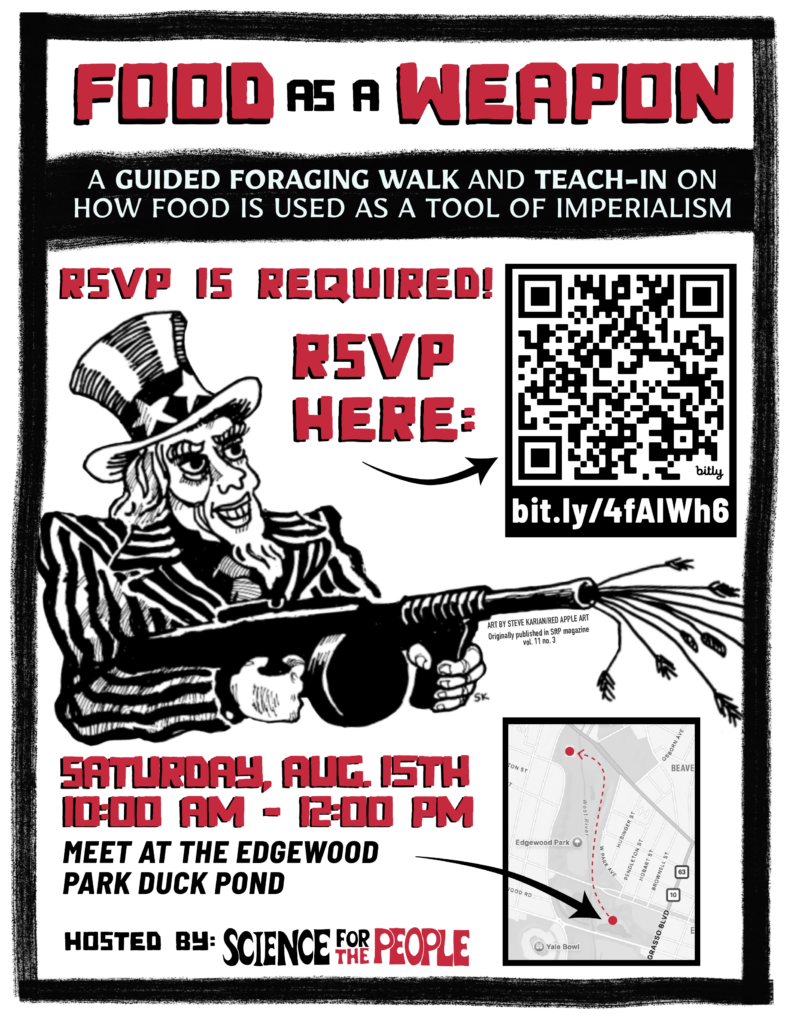
RSVP HERE: https://actionnetwork.org/events/food-as-a-weapon-a-guided-foraging-walk-and-teach-in/
Foraging is, for many, an increasingly popular hobby done with friends, family, and local foraging clubs. For many others, foraging has long been a cultural tradition, a strategy for survival, and even a method of resistance.
In October 2025, we in Science for the People – New Haven ran a teach-in event focusing on the political landscape of foraging, combining a foraging walk with discussions on the ways in which the practice of foraging has always been political.
We are pleased to present the sequel event, which will focus on how food is used as a weapon in the context of imperialist ambitions. While we go on another foraging walk in our local New Haven neighbourhoods, we will ask questions like: What were the foraging and farming practices of the Indigenous peoples of CT, and how were they affected by the inherent settler-colonialism in the founding of the United States? How is starvation used as a deliberate tactic in wars and imperialist aggression, from Cuba to Palestine? What were the intentional, human-made causes of the Bengal famine? How are monoculture and seed cultivation practices used to exert economic and agricultural control over the Global South?
Join us for this combined discussion and guided walk event to explore these topics and our local environments!
In preparation for this event, we ask that all attendees review the resources linked below and engage in-depth with the first resource [#1] * and * at least two of the remaining six resources [#2 – #7]. The written resources relate to our topic of food being used as a weapon of war and imperialism, and our discussion will be guided by these.
We will be meeting at the Duck Pond (also called Edgewood Park Pond) in Edgewood Park and ending at the gazebo (where the CitySeed farmer’s market is held). The event will involve about an hour of walking over a one-mile trail. Please dress in appropriate walking shoes, bring water and a cap for the Sun if you need, and be mindful of the weather!
Resources
[1] From Indigenous Foodways to the “Trail of Tears”
Reconnecting with Mother Earth: Foraging with Indigenous Values – NATIFS
Some initial questions:
a) What is your approach to foraging – do you have or take the time to observe and study nature?
b) Are you using identification apps? Are they helpful for you? Do you think they bring you closer to nature or keep you connected to technology?
[2] Hunger on the Trail of Tears
https://www.nobelpeacecenter.org/en/news/hunger-on-the-trail-of-tears
Summary: The Trail of Tears, in the 1830s, was a significant event in United States governments’ policy of extermination and starvation of the Indigenous Peoples of Turtle Island. Forced starvation and controlling food resources played a central part in this policy. Destruction of crops and food stores was used by European settlers to drive Indigenous tribes in the East to newly allocated areas in the West. U.S. leaders also found it easier to kill bison, an important food source for numerous tribes, than wage all-out war against Indigenous Peoples. In this manner, control of food and starvation were important aspects of the settler-colonial practices carried out during and after the founding of the U.S. that were aimed at the genocide of Native Americans.
[3] Cuba: sanctions to punish the population
Memorandum From the Deputy Assistant Secretary of State for Inter-American Affairs (Mallory) to the Assistant Secretary of State for Inter-American Affairs (Rubottom)
https://history.state.gov/historicaldocuments/frus1958-60v06/d499
Summary: This memo, officially declassified in 1991, was written in 1960 by then-Deputy Assistant Secretary of State for Inter-American Affairs, Lester Mallory, imploring that “every possible means should be undertaken promptly to weaken the economic life of Cuba”, including inducing starvation among the population, in order to undermine the revolutionary communist government. The United States instituted an embargo on Cuba the following year, which continues to this day.
[4] How British colonizers caused the Bengal famine
https://newint.org/features/2021/12/07/feature-how-british-colonizers-caused-bengal-famine
Summary: Britain for a long time claimed that the 1943 famine in Bengal was an unavoidable natural disaster, but researchers today agree that it was human-made, and war-time inflation made food inaccessible to millions of people in Bengal — leading to 3million+ deaths and many more being pushed deeper into poverty. Utsa Patnaik (Indian marxist economist) has suggested that the war-time inflation was a deliberate policy designed by John Maynard Keynes and Winston Churchill, to deprive Bengalis living in poverty of resources and transfer them to British/US troops and support WWII activities.
[5] The New “Green Revolution” for Africa: A Revolution for Farmers, or for Corporate Profits?
https://magazine.scienceforthepeople.org/vol25-1-the-soil-and-worker/the-new-green-revolution-for-africa/
Summary: This article discusses the impact of the Gates Foundation and the Alliance for a Green Revolution in Africa (AGRA), a non-profit founded by the Gates and Rockefeller Foundations, on food sovereignty, agricultural systems, and small farmers and in Africa. AGRA claims to seek a “transformation” of African agriculture through a “green revolution”, but in reality, the article argues, this takes the form of nothing more than a forced industrialization of African agriculture in order to “open up new markets for industrial and chemical-intensive agriculture in Africa.” Meanwhile the Gates Foundation and other philanthropic institutions ensure that decision making and sovereignty remain out of the hands of African farmers and guided by corporate and imperial desires instead. This article includes an interview with Daniel Maingi, Programs Manager at Growth Partners Africa and Coordinator of the Kenya Food Rights Alliance.
[6] Gaza: evidence points to Israel’s continued use of starvation to inflict genocide against Palestinians
https://www.amnesty.org/en/latest/news/2025/07/gaza-evidence-points-to-israels-continued-use-of-starvation-to-inflict-genocide-against-palestinians/
Summary: By continuing to prevent UN and other key humanitarian organizations from distributing certain essential items, like food parcels, fuel and shelter, within Gaza and by maintaining a deadly, dehumanizing and ineffective militarized ‘aid’ scheme, Israeli authorities have turned aid-seeking into a booby trap for desperate starved Palestinians. They have also deliberately fueled chaos and compounded suffering instead of alleviating it. The aid delivered is also way below the humanitarian needs of a population that has been experiencing almost daily bombings.
[7] Excerpts from After Hunger: In Conversation with Sean Sherman
Link to excerpts from the article
Summary: Sean Sherman, “The Sioux Chef,” describes how colonization devalued complex local knowledge systems and destroyed complex local food systems and connects educational sovereignty to food sovereignty. Sherman observes that hunger and ill health are endemic features of colonialism and the globalized, commodified food systems that have emerged out of Western imperialism. For Sherman, learning from the past and building on foundations of local indigenous knowledge systems, and the food traditions of peoples who “held a strong sense of the wild plants where they lived, utilizing nature’s botanical components—trees, roots, flowers, fruits, seaweeds,” offers a pathway forward to a vision of better individual, societal, and planetary health.
—————
Additional recommended reading (optional) for context local to New England:
[1] Indians 201: Aboriginal farming in New England – Daily Kos
Summary: Foraging was an important part of the indigenous diet, in addition a lot of agriculture was done that often evaded the eyes of the European settlers
[2] The Pilgrims Had No Idea How to Farm Here. Luckily, They Had the Native Americans – Modern Farmer
Summary: The “Pilgrims” would not have survived if the local indigenous people of the Wampanoag wouldn’t have helped them by introducing them to local foods that grow in the coastal soil. Indigenous techniques of using plants that support each other and ash and fish as fertilizer was the basis for the survival of people in this region.